
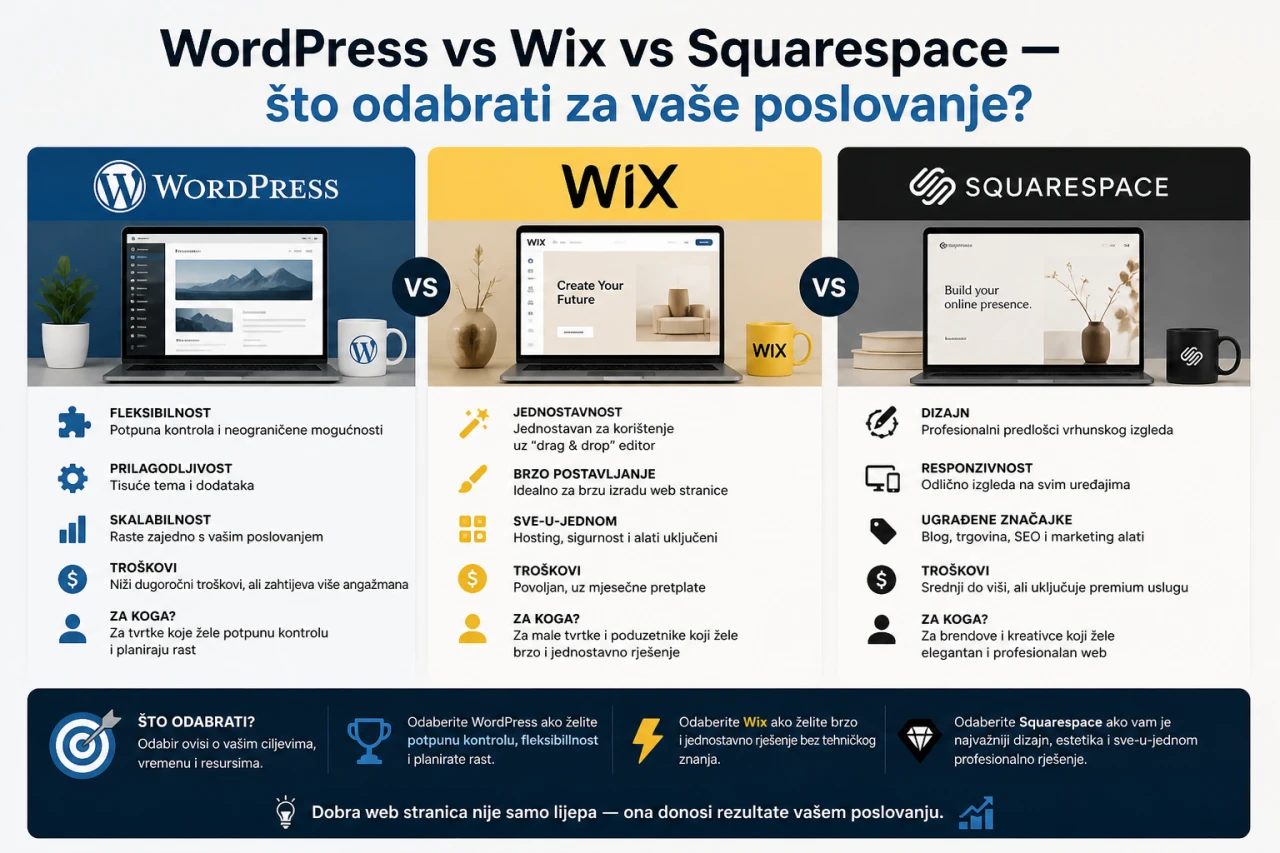
When you decide it’s finally time for a professional website, you’re faced with your first big decision: which platform to choose? WordPress, Wix, and Squarespace are the names most often mentioned, each with vocal advocates and equally vocal critics. The ads tell you it’s easy and fast, but the reality is a bit more complicated — and choosing the wrong platform can cost you time, money, and nerves.
There are no marketing pitches in this article. We compare all three platforms as they are — with pros, cons, and a clear recommendation for each type of business.
What is really important when choosing a platform?
Before we get into the comparison, it’s important to know what you’re looking for. Many business owners choose a platform based on commercials or recommendations from friends — and that rarely ends well. The real questions to ask are: How much control do I need over the look and functionality of the site? How technical am I? Do I plan to grow and add functionality? How much content will I edit myself? Will I sell online?
Depending on the answers, each platform has its ideal user — and its user who should stay away.
Wix — fast, visual, limited
Wix was created with one idea: to allow anyone to create a website without any technical knowledge. And it really succeeded. The drag-and-drop editor is intuitive, there are hundreds of ready-made templates, and a basic site can be online in a matter of hours.
For a personal blog, hobby project, or a very simple presentation site, Wix can be just enough. The pricing plans are affordable, and everything is included in one place — hosting, domain, SSL certificate.
However, Wix has a few serious limitations that become apparent as your needs grow. Once you choose a template, you can’t change it without building a site from scratch — all your content remains on the old template. Advanced SEO capabilities are limited compared to WordPress, and URL structure and technical SEO elements can be a problem for serious organic growth. If you ever decide to migrate to another platform, it’s nearly impossible without a complete rebuild — your content is “trapped” within the Wix ecosystem.
The performance of Wix sites can be slower than the WordPress equivalent, and loading speed directly affects Google ranking and conversions. For a local business with five subpages, this may not be critical — but for a serious business that wants to grow, it’s a problem that piles up.
Wix is a platform where you pay a subscription fee forever and own nothing. If tomorrow Wix decides to raise prices or shut down a certain functionality, you have no alternatives. The site is theirs, you are the tenant.
Squarespace — design aesthetic, closed ecosystem
Squarespace is known for one thing: templates that look like they were designed by a professional studio. Visually, it’s probably the most attractive platform of the three, and that’s no accident — the founders have targeted creatives, photographers, designers, and small boutique brands that put aesthetics first.
If you run a photography studio, gallery, fashion brand, or restaurant where the visual feel of your site directly reflects your brand, Squarespace is a great option. Everything looks clean, modern, and professional — without a lot of effort.
But like Wix, Squarespace is a closed ecosystem. There are no plugins, no third-party extensions, no code customization without advanced technical knowledge. You get what Squarespace offers — no more, no less. For simple needs, that’s more than enough. For the specific functionality your business requires — contact forms with conditional logic, booking systems, integrated CRM, custom landing pages — you’ll hit a wall.
The SEO capabilities are better than on Wix, but still fall short of what WordPress offers. By blocking certain technical access to the site, Squarespace limits what you can do with search engine optimization.
The price is higher than Wix and is paid annually, and the e-commerce plan that includes all the functionalities of the web store costs significantly more. And here you are a tenant of someone else’s platform — migrating to another platform means creating a site from scratch.
WordPress — freedom, flexibility, ownership
WordPress powers 43% of all websites on the Internet — from personal blogs to the websites of Fortune 500 companies, media outlets, government institutions, and global e-commerce giants. This dominance is not a coincidence or a fluke of market circumstances. WordPress has survived and outlasted dozens of competitors because it offers something no other platform can replicate: complete freedom and complete ownership.
Your WordPress site is yours. You install it on the hosting of your choice, you have direct access to all the files and the database, you can move it to another hosting in a few hours, you can sell it along with the business, you can access and manage it regardless of what happens with any third party.
The WordPress plugin ecosystem has over 60,000 free and paid extensions. Need a booking system? There’s a plugin. Need a multilingual site? There’s a plugin. Need integration with your CRM system, email marketing, invoicing system, live chat? There are solutions for all of these that you can install in a few clicks — without coding.
WordPress’ SEO capabilities are incomparably better. Plugins like All in One SEO or Yoast SEO give you full control over technical SEO, and with proper optimization, WordPress sites regularly outperform Wix and Squarespace equivalents in Google results. Loading speeds can be excellent with the right theme, caching, and image optimization — and that’s in your hands, not the platform’s.
The flexibility of WordPress comes with certain responsibilities. Regular updates to WordPress, themes, and plugins are essential — outdated software is a security risk. You need to set up a backup system. You have to choose and pay for hosting separately. For someone who wants a completely hands-off approach and doesn’t plan on having technical support, this can be a burden.
But this is exactly where the role of a professional agency comes in. When you work with an experienced WordPress partner, all that technical worry falls on them — you get all the benefits of the platform without the headaches.
Comparison in numbers
When we look at real costs over the long term, the picture is often different from what advertising materials show.
Wix and Squarespace charge monthly or yearly subscriptions that grow with functionality — basic plans are affordable, but as soon as you need e-commerce, advanced analytics, or removing Wix/Squarespace branding from your site, the price goes up. And you pay it forever, every year, with no way out.
WordPress hosting for a more serious site starts from 5-15 euros per month for shared hosting, up to 30-80 euros for managed WordPress hosting with better performance. Once the site is built, the ongoing costs are predictable and low. There is no platform rental fee.
To create the page itself, WordPress requires a larger initial investment — quality creation starts from 500 euros for a simple presentation page, to 2000+ euros for complex projects. But that’s a one-time, non-recurring cost, and the site stays yours no matter what.
Which platform is right for you?
The answer depends on your specific circumstances, but we can provide clear guidance.
Wix is a good choice if you’re just exploring an idea, don’t have the budget for even a minimal professional project, and know the site will be temporary or very simple. For a serious business, Wix is rarely the right choice.
Squarespace makes sense if you’re a creative, photographer, or boutique brand where visual appeal is as important as functionality, and your needs are relatively simple and static. If you know you won’t need advanced features or aggressive SEO growth, Squarespace may be the right solution.
WordPress is the right choice for almost any serious business. If you plan to grow, if SEO is important to you, if you need specific functionality, if you want your own digital space that does not depend on other people’s decisions — WordPress is the only logical option. That’s why it is used by both global brands and local craftsmen who know what they are doing.
At the Media-met agency, we work exclusively with WordPress — and that’s no coincidence. After 15 years of experience building websites, we have seen too many clients who started with a “quick and cheap” solution, and a year or two later paid twice as much for migration and reconstruction. WordPress from the start means less hassle in the long run, more freedom and a site that really works for your business.
If you are not sure which platform is right for you, schedule a free consultation . Together, we’ll find a solution that fits your needs and budget—no sales pressure and no hidden costs.